Transcript
At about eight o'clock on the night of February second, eighteen ninety, the steam whistle at the Custer mill started to blow.
A newspaper wrote it up two days later. The people knew too well what that whistle meant. And when they started out toward the disaster, they took their shovels with them.
We'll come back to that night. First I want to tell you how a town came to be there at all, hundreds of miles from a railroad, and why the county I live in is still called Custer.
This is The Borah Vista Podcast, stories from the mountains of central Idaho. I'm Jason. A quick note before we go on. The voice you're hearing is an AI copy of my own voice, and this script was researched and written with AI tools, from the sources in the show notes. This one is about Custer, a ghost town on the Yankee Fork of the Salmon River.
The Wrong Name
On August seventeenth, eighteen seventy-six, three prospectors named Baxter, Dodge and McKeim were working a hillside above the Yankee Fork, and they found a vein of gold ore.
Fifty-three days earlier, and a long way east of there, George Armstrong Custer had died at the Little Bighorn. So they called their find the General Custer. Nothing I've found puts the general anywhere near this place. A few years later, when this part of Idaho became a county, the county took its name from the mine. So the county I live in is named after a mine, and the mine is named after a man who had just been killed somewhere else.
The mine itself was a gift. Most of the time a prospector has to tunnel into a mountain just to find out what he's got. Here, the rock that should have been covering the vein had already slid off. One account says a snowslide exposed it. One man could pull down twelve tons of ore in a day. The owners broke it loose, tumbled it down the hill, sorted it, sacked it and shipped it to a mill in Salt Lake, and that one small digging, open to the sky, brought in sixty thousand dollars.
If that account is right, snow is what opened this place up. Hold on to that.
Then nothing happened, because the lawsuits arrived. The claim went through two or three sets of buyers, all of them fighting over who owned what. One man paid sixty thousand dollars for a disputed two-thirds share, and a writer in Salt Lake joked that it was a big price for two-thirds of a lawsuit. The three men who found the vein did fine. They eventually got sixty thousand, a hundred and five thousand, and a hundred and twenty-one thousand dollars, depending, it seems, on how long each of them held out.
The Rush That Wouldn't Come
Back up a few years. The Yankee Fork had a habit of being ignored. A party of Yankee prospectors gave the stream its name in the eighteen sixties and left. In eighteen seventy, miners came over the mountains from Loon Creek, and most of their claims were a disappointment.
Then, on a Sunday afternoon in June of eighteen seventy-five, a man named W. A. Norton went looking for wherever the creek's gold was coming from. He found a band of ore only two or three inches thick, the start of the Charles Dickens mine, and it was so rich that he and a partner pounded out eleven thousand five hundred dollars by hand, with a mortar, in thirty days. Almost anywhere else, that starts a stampede. Here, almost nobody noticed. Winter came early that year, and the mule packers couldn't get supplies in. The population of the entire Yankee Fork fell to three.
That number only counts the newcomers. The people who lived in these mountains were Shoshone, the bands known as the Tukudeka, or Sheepeaters, and the Agaiduka, or Salmon Eaters. A history of the state park describes a seasonal way of life here going back as much as eight thousand years, and one village north of Clayton where about thirty families wintered together. In eighteen sixty-eight they signed a treaty. Congress never ratified it.
The rush finally came in the spring of eighteen seventy-nine. The Salt Lake Tribune reported the roads lined with stampeders, on foot, on horseback, in bull teams and shaky wagons. That July, one writer figured seven or eight thousand people had come into these mountains that season, and two thousand were around the new camp of Bonanza. And many of them were already leaving, because there was hardly any work yet. There was no big mill, and no wagon road. By fall, Bonanza was down to several hundred.
That same spring, the army rode out of Boise after the Sheepeaters. They were blamed for killings of ranchers and Chinese miners, and one history of the campaign says there was no evidence for it. The campaign ended that fall with a surrender, and the people taken were sent to the Fort Hall Reservation. So the same year the crowds finally came up the trail, the army was removing people from these mountains.
Two Bets
Now meet the man who started the town of Custer. The walking tour you can pick up on site gives a wonderful portrait of him. Samuel Holman, Sammy, born in eighteen thirty-five in Saratoga, New York. He graduated from Harvard Law School and had a promising career, and he threw it away after his fiancee died. He headed west and wound up on the Yankee Fork. Bonanza elected him its first justice of the peace, and he had a name for being fair and honest. The tour says he could have gone far in politics, except for two things: gold fever and drinking.
In the summer of eighteen seventy-eight, before there was any mill, Holman picked out a heavily forested shelf of flat ground below the mine. The trees were cleared and the logs stacked in big piles, and later they were sawn into lumber for the town. He built a cabin and sold lots. What grew there was one narrow main street, about half a mile long. That was the first bet, a town before there was any mill.
The other bet was on the mine, and it was made by Joseph Pfeiffer of Rocky Bar, another Idaho mining town. In the spring of eighteen seventy-nine he showed up with engineers and money from San Francisco and started buying his way through the fight over who owned it. A later account says people generally thought he was crazy. The Custer mine was still barely developed, at the end of a pack trail. Everything came in and went out by pack train, fourteen to twenty animals carrying about three hundred pounds each, making twelve to fifteen miles a day. Then a toll road went in from the town of Challis, and in October of eighteen seventy-nine the stagecoach reached Bonanza. Over that road came a thirty-stamp mill, thirty heavy iron hammers rising and dropping to crush the ore so the gold could be gotten out of it. It was finished at the very end of eighteen eighty.
In eighteen seventy-nine, with all that excitement, the Yankee Fork mines produced four hundred and twenty thousand dollars. In eighteen eighty-one, with the mill running, they produced more than a million. The Custer mine ran steadily for over a decade and turned out about eight million dollars, well over half of everything the Yankee Fork would ever produce. Pfeiffer wasn't crazy.
Lizzie King
A couple of miles down the road from Custer is the older town, Bonanza. Very little of it is left. A mile west of town there's a small plot called Boot Hill, with three graves in it. The Forest Service calls what happened there the Yankee Fork's most famous and most puzzling legend.
Lizzie King and her husband Richard came to Bonanza in eighteen seventy-eight. He worked in real estate. In July of eighteen seventy-nine, an argument ended with his business partner, William Dillon, killing him. One account says Dillon got a ten-year sentence. Lizzie and a close friend named Charles Franklin bought a gravesite for Richard and two more beside it. Presumably, the Forest Service says, for themselves.
Lizzie stayed. She built her own business, the Yankee Fork Dance Hall, and it opened in May of eighteen eighty. By the Forest Service's telling, she and Charles Franklin were courting and a wedding seemed likely. Then she went to Butte, Montana, looking for employees, and when she came back, a man named Robert Hawthorne was with her. On August fifth, eighteen eighty, she married him. Six days later, she and Hawthorne were both found shot to death.
This is the part everybody tells. Franklin buried them next to Richard. He left off her married name. And on her marker, instead of the date she died, he put the date she married the other man. Then Franklin left, and lived in a secluded cabin near Stanley. Years later, the story goes, he was found dead with a locket in his hand, and in the locket was a picture of Lizzie King. People in Bonanza chose to bury their dead elsewhere, which is why those three are alone up there.
The Forest Service asks the question straight out: who killed them, and could Franklin have killed the woman he loved? The sign at Bonanza calls her death a mystery. There's an old western ballad, The Grave of Lizzie King, that people take to be about her. The story has been told as a mystery for a very long time.
But there's another account, from August of eighteen eighty, the month it happened. A letter from someone in Bonanza, dated the eleventh, was printed in a Sacramento paper. According to that letter, Hawthorne was believed to have sold a mine for several thousand dollars. After the wedding, it turned out he had no money. They quarreled. He shot her, and then himself. People heard the shots and found them both dead, with the revolver near his hand.
That's one letter. Nobody saw it happen, and I can't tell you it's right. Franklin was never arrested, as far as anyone has written. But it does make me wonder how much of the mystery got added later, because a man with a locket is a better story than a fight about money. Either way, in about thirteen months Lizzie King buried a husband, opened a business of her own, married again, and died.
The Town Alive
Back up the road, the town of Custer was growing. At its height, the state's survey lists three general stores, a hotel, a Wells Fargo office, two barbers, a butcher, a dance hall, five saloons and four red-light houses. Prize fights were staged at the Casto and McGee Saloon, between the Custer champion and men from other camps. The walking tour says the women in those houses were shunned by most respectable women, and were also known for caring for people when they got sick and for giving to the poor.
There was a man everybody called Judge Davis. Davis served as justice of the peace, and he was a carpenter by trade. He made most of the coffins used in Custer and Bonanza. One account says a pine coffin and an outer box ran you thirty dollars. Remember him too.
Here's a detail I love. Five saloons, four red-light houses, and in the whole Yankee Fork district, the only church anyone ever built was a Joss House, a Chinese temple. It stood in Custer's Chinatown, at the lower end of town. One account of the eighteen eighty census counts two hundred and thirteen people in Custer, forty-nine of them Chinese. The park's history says prejudice kept them from owning mining claims, so they worked other people's claims, and worked as cooks and ran laundries. Another account says the town barred them from living inside its limits.
One of them was a miner called John Taylor. He was called Taylor, the park's history says, because the people of Custer couldn't pronounce his real name. The stone from his cabin is still there. A local burial record says that when he died, his coffin slipped off a wagon from Custer and slid down the hill. The coffin stayed there until spring, when they could get to it and finish the burial. He's in the Chinese section of the cemetery at Bonanza. I don't have the name he was born with.
Selling The Hole
Now back to the Custer mine. Remember how easy it was at the start, with the vein lying out in the open? It turned out that was most of the ore. About eighty percent of the mine's ore was in that exposed part of the vein, and the best of the rock had been through the mill by eighteen eighty-six. In other words, the richest part was already gone.
Eighteen eighty-six also happens to be when British money started pouring into Idaho mines. A new British company, organized under a rear admiral in the Royal Navy, bought the old Charles Dickens mine, the one Norton found, that summer, right after it had been sold off to pay its debts. The next year the company raised its money to four hundred and twelve thousand pounds and bought the Custer mine and mill too. It became the Dickens-Custer Company, Limited. In London, more people wanted the stock than there was stock to sell. In February of eighteen eighty-eight, one-pound shares were selling for more than a pound.
Later that year, the investors learned that company officials had been manipulating the stock. The company lost thirty-seven thousand pounds over four years, even with more than a hundred men working for it. In October of eighteen ninety-two the company shut down. The state's history puts it about as plainly as a state history can: some large, played-out western mines had been unloaded on an unsuspecting London market.
Back To The Whistle
So that's who owned the mill on the night the whistle blew: February second, eighteen ninety, about eight o'clock. The newspaper was the Challis Messenger, and the whistle was the alarm. People in Custer knew what it meant because avalanches were common there.
Two avalanches came off the top of Bald Mountain. They crashed through two houses, H. Levinson's and Nels Johnson's. The sign in Custer says one of them flooded the Johnson house with snow, lifted it off its foundation, spun it around and sent it across the Yankee Fork. The town went out with its shovels. Some people were pulled out alive that night. Some weren't so lucky.
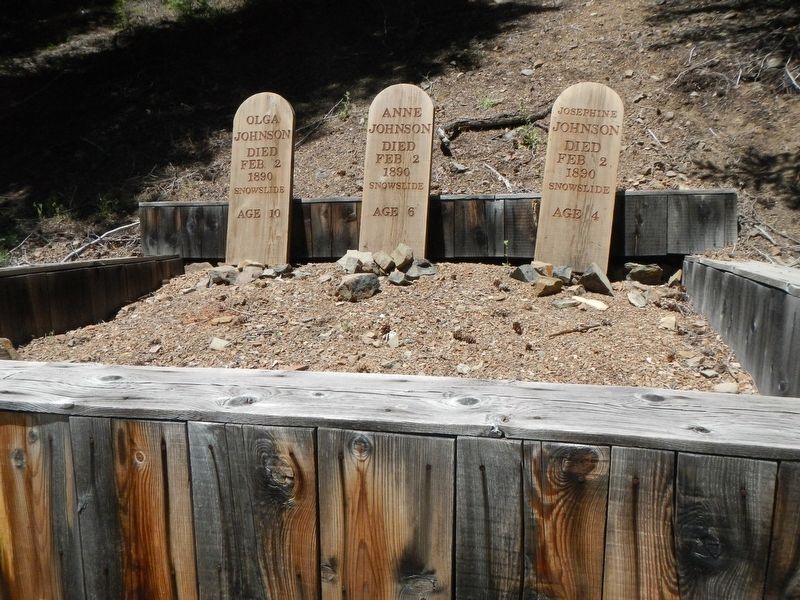
Olga Johnson was ten. Annie was six. Josephine was four.
They're buried in Custer, behind where the old school stands. The walking tour says they were laid close to their friends, the people of Custer. The wooden markers there today give each girl's name, her age, the date, and one word: snowslide. Snow opened this place up, if that one account is right. It also did this.
The Last Boom
After the British left, the valley went quiet. One newspaper report in eighteen ninety-four found only four men mining on the Yankee Fork. Then, in eighteen ninety-five, a new outfit called the Lucky Boy bought up the British holdings and started mining another vein, running alongside the Custer's, and sending the ore through the same mill. The town of Custer reached its peak in eighteen ninety-six, about six hundred people. Bonanza had burned in eighteen eighty-nine, and in May of eighteen ninety-seven it burned again, and many of its merchants moved up the road. For the first time, Custer was the center of everything.
On September fourth, nineteen hundred, Judge Davis, the coffin maker, started building the new schoolhouse. Attendance reached upwards of forty kids, and school ran three to six months a year. The school went up right beside the place where the Johnson girls had been buried ten years before.
The Lucky Boy's ore never really ran out. It stayed just as good as they dug deeper. But it had to be hauled up a steep shaft, and every extra foot cost more, until the hauling ate the profit. In nineteen oh four, after producing about a million dollars, the mine stopped. People hung on, hoping for a new tunnel. By nineteen ten, one count says a dozen families were left. Another says sixty-six people across both towns. In nineteen eleven the nearby Sunbeam mine shut down too, and a newspaper that year counted two families in Custer.
And Sammy Holman? At fifty-nine he was still prospecting, and he sold a silver find near Clayton for twenty-seven thousand dollars. The walking tour says the debonair young lawyer was gone by then, and what was left was a small grizzled man in mended shoes with scraggly white whiskers. He spent the rest of his life in a cabin beside a small stream that's now called Holman Creek. He died in nineteen ten, the same year the Forest Service says Custer became a ghost town.
The Ghost Town Twist
But a ghost town doesn't just sit there. In the nineteen thirties, during the Depression, unemployed men and their families moved into the deserted town and prospected for gold. Some of what's standing today, like the assay office and the transportation building, dates from those years, not from the boom. From nineteen thirty-nine to nineteen fifty-one, on and off, a giant dredge, a floating machine that dug gold out of the riverbed, worked the river below town. You drive past the piles of rock it left on your way up.
Here's the part I didn't expect. The town's National Register nomination, written by the Idaho State Historical Society in nineteen seventy-four, says that about nineteen sixty, the majority of the buildings in Custer were destroyed by the Forest Service, as fire hazards. This was a town that once had more than a hundred buildings on that one street. A real fire took the blacksmith shop and the jail in nineteen sixty-four. So what you walk through in Custer isn't simply what time left behind. It's what was still there after the Forest Service and the fire.
Right around the time the buildings were coming down, a couple started saving what they could. In nineteen sixty, Tuff and Edna McGown opened a museum in the abandoned schoolhouse. Their friend Esther Yarber published a book on the area in nineteen sixty-three, and it drew people to Custer. The Forest Service bought the museum in nineteen sixty-six. Custer went on the National Register in nineteen eighty-one. And in nineteen ninety, the state joined in, and they restored the school.
The Note
During that restoration, they found a note. It was under the school, a child's handwritten note, more than eighty years old by then. The sign in Custer quotes it, and here it is, word for word. Jennie Smith, Mae Dellen, Lida Pfeitter, Stella Mavity, and Emma Mallm, think their selves smart. They put them little kids up to that. And if that Sade Smith bothers me, I will pound the stuffing out of her. Also Gladys, Annie and Josie.
The sign doesn't say who wrote it. Those were real kids, though. A nineteen ninety-eight newspaper story has Mae Dellen in that school in its first year, and you can still walk to the Pfeiffer house in town. And the Annie and Josie in the note can't be the Johnson girls, who had died ten years before that school was started. These were other children, furious at each other, on the same ground.
So that's Custer. The county is named after a general who, as far as I can tell, never saw the place. The money came and went through San Francisco and London. And the names that stayed are on three wooden markers behind a school, on a grave up at Boot Hill, and on a scrap of paper found under a building. One young man doesn't even have that. He fell during a Fourth of July climbing contest, and his friends buried him near the town flagpole. The tour says his name has been lost.
You can go see it. It's free, and you can walk the grounds any time you can get there. Free tours run from Memorial Day to Labor Day, and Custer Days is the second Saturday in July. Bring water, because there's none to drink. From Mackay, it's a little over a hundred miles, close to three hours, through Challis and down Highway 75 to Sunbeam, then up the Yankee Fork road past the dredge. Everything you need to plan it is in our trip guide, at borah vista dot com slash guide. Stop at Bonanza on your way. And read the sign at the school.
This has been The Borah Vista Podcast. I'm Jason. Thanks for listening.
Sources
- Idaho State Historical Society, Reference Series 204: Yankee Fork-Robinson Bar
- Custer Historic District, National Register nomination
- Salmon-Challis National Forest: Custer Ghost Town
- Salmon-Challis National Forest: Boot Hill Cemetery
- Family Tragedy marker
- Custer School marker
- Bonanza City marker
- Western Mining History: Custer
- Legends of America: Bonanza and Custer
- Find a Grave: Agnes Elizabeth King Hawthorne, quoting the Yankee Fork Herald
- Sacramento Record-Union, Aug 27, 1880 (known to us secondhand only)
- Deseret News, June 28, 1998
- Wandering Idahoan: Custer City
- Custer Walking Tour, on the Forest Service Custer page, with the Challis Messenger report of Feb 4, 1890
- Land of the Yankee Fork State Park narrative
- Photo of the Johnson markers
- Bonanza Cemetery listing, Custer IDGenWeb
- Intermountain Histories: Sheepeater War